Raja Ravi Varma: The Painter Who Gave India's Gods a Human Face
By fusing European academic technique with Indian classical tradition, Ravi Varma created images that shaped how an entire civilisation pictures its mythology.

A Meeting of Two Worlds
In the second half of the nineteenth century, most Indian painting inhabited one of two worlds: the miniature tradition of the Mughal and Rajput courts, or the formal portraiture demanded by British administrators and local rulers who wanted something that looked "European." Raja Ravi Varma belonged to both worlds and was limited by neither. He learned the grammar of Western academic oil painting — perspective, chiaroscuro, modelling in light — and then used it to depict the heroes, heroines, and deities of Sanskrit literature with an intimacy and psychological naturalism that no previous Indian artist had attempted.
Born in 1848 in the royal household of Kilimanoor in the princely state of Travancore (now Kerala), Varma showed early talent and was encouraged by the Maharaja of Travancore, who invited him to study with a Dutch court painter named Theodore Jensen. The collaboration was formative: Varma absorbed Jensen's technical methods and then, crucially, applied them to entirely Indian subjects.
The Academic Masterworks
Varma travelled extensively across the subcontinent, sketching and studying regional costumes, architecture, and physical types. He was adamant that his mythological figures should look genuinely South Asian — that Sita should have a Tamil or Keralite face, not a European one draped in Indian dress.


His large, salon-style canvases are theatrical in the best sense. "Shakuntala," depicting the forest-dwelling heroine of Kalidasa's celebrated drama at the moment she is distracted from her prayers by love, is a study in gentle inwardness. The figure is absorbed, slightly dreaming, surrounded by the dappled greens of the forest — a painting of mood more than action.
His depictions of the goddess Lakshmi became canonical: robed in red and gold, rising from the lotus, flanked by elephants, her face serene and approachable rather than hieratic. His "Saraswati," goddess of learning and the arts, and his images of Radha and the infant Krishna brought similar warmth to subjects that had previously been rendered in the flatter conventions of traditional icon-painting.
The Ravi Varma Press and Mass Reproduction
Varma's reach extended far beyond what any individual painter could achieve. In the 1890s he established the Ravi Varma Fine Arts Lithographic Press in Bombay (now Mumbai), which produced oleograph prints — chromolithographic reproductions — of his paintings at prices accessible to middle-class Indian households. For the first time, a family of modest means could hang a large, coloured image of Lakshmi or Durga in their home.
The consequences were profound. Varma's compositions did not merely enter Indian popular culture; in many contexts they defined it. The particular appearance he gave to these deities became the visual norm, influencing calendar art, cinema, and religious iconography throughout the twentieth century. You encounter his legacy — often unattributed — in bazaars, temples, and living rooms across the subcontinent today.

A Contested but Essential Legacy
Later nationalist critics, particularly in Bengal, sometimes dismissed Varma's naturalism as an excessive accommodation to European taste. But this debate has shifted over time. Contemporary art historians tend to see his synthesis as genuinely original rather than derivative — a case of a colonised culture using the coloniser's tools to insist on the beauty and dignity of its own stories.
Varma died in 1906, leaving behind a body of work that spans portraiture, mythological narrative, and domestic scene. His formal training was European; his imagination and his subjects were entirely his own.
On Mojud you can explore around 126 of Raja Ravi Varma's works — from intimate female portraits to grand mythological canvases. Browse the collection at Mojud, download your favourites for free, or order a high-quality print and bring one of these luminous images into your home.
 Mandodari · 1910
 Bharat Milap · 1910
 Vasantika · 1910
 Damayanti Vanavasa · 1910
 Radha and Sakhi · 1910
 Kadambari playing sitar · 1910
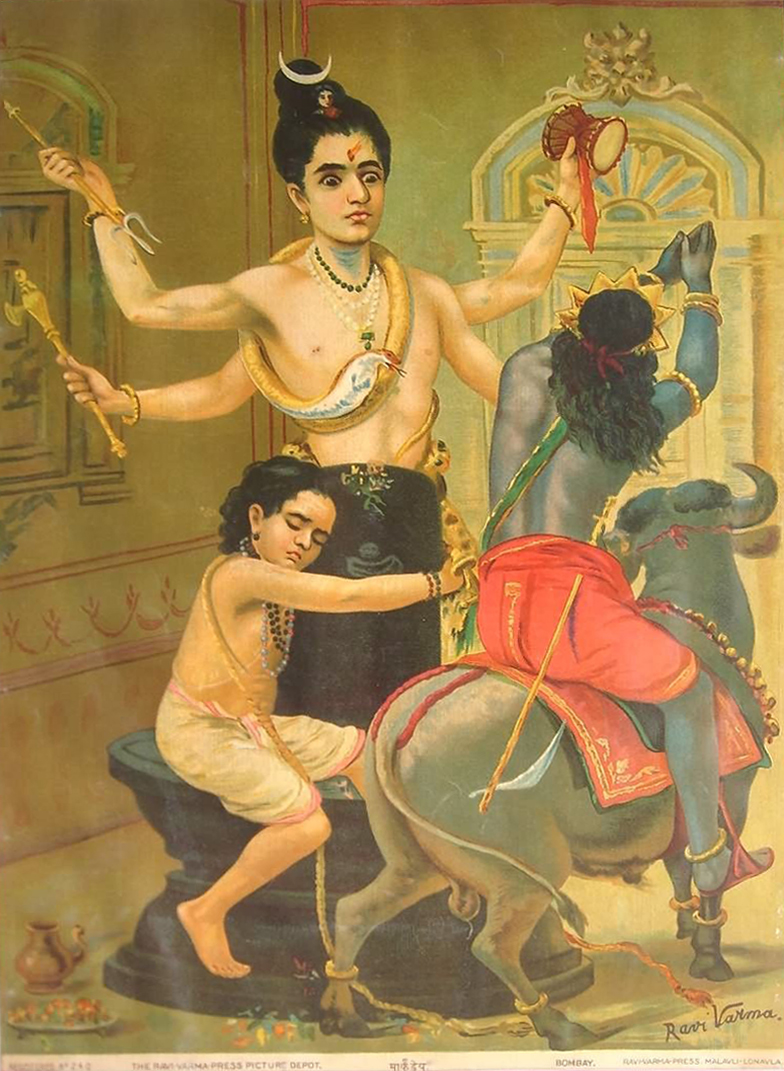 Markandeya · 1910
 Matsya Raja Ravi Varma Press · 1910


- Paul Gauguin: Colour, Myth, and the Edge of the WorldArtist
- Vincent van Gogh: A Life Burned BrightArtist
- Claude Monet: Light, Water, and the Invention of ImpressionismArtist
- Édouard Manet: The Scandal That Made Modern ArtArtist
- Amrita Sher-Gil: The Painter Who Bridged Two WorldsArtist
- Gustav Klimt: Gold, Desire, and the Viennese ImaginationArtist